Maxima


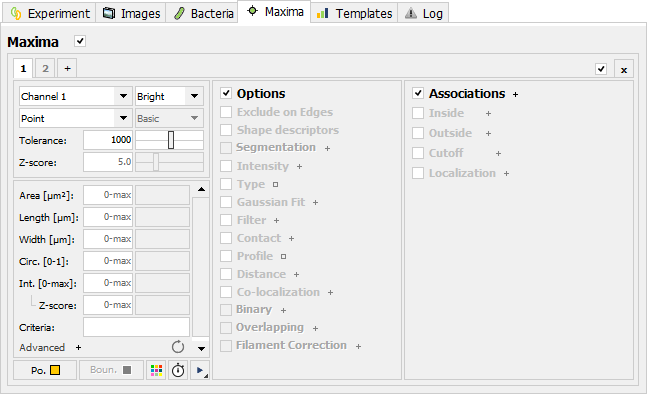
This panel contains settings related to the detection of particles using a local maxima detection algorithm (see ImageJ Local Maxima Detection for more details). Different category of Maxima can be detected using specific parameters. Each type consists of specific attributes (tolerance, z-score, shape and signal intensity) designed to detect and evaluate objects in the specified channel of the active Image and specific options (mode, colors) used to generate the final particle. Note that different category of Maxima can be detected on the same channel. Press  to add a new category or
  to remove the active category. Analysis is performed on the existing rectangular selection or on the entire image if no selection is present.
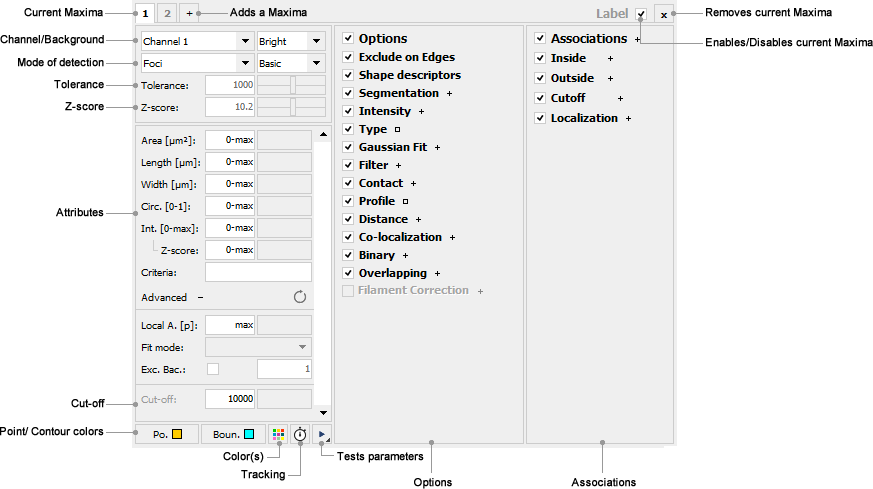
Figure 9: The maxima panel.
Channel: Allows any of the five different channels (1-4) of the active image to be selected for the Maxima detection. Select “Binary” to use an existing binary mask instead of local maxima detection.
Background type: Selects the type of background. Select “Dark”, if the image background is darker than the particles to be found. Select “Bright”, if the Image background is brighter than the particles to be found.
Mode of detection: Allows any of the different modes of Maxima detection to be selected. Four modes of detection are available: Point, Foci, Bacteria and Filament.
Point: Particle centers are defined by the local maxima.
Foci: Particle centers are defined by the local maxima. Particle contours are defined using the contiguous area surrounding the local maxima (see z-score for more details). The Area, Circularity, Length (approximated by the maximum caliper), Width (approximated by the minimum caliper) and Signal intensity are measured and used as attributes.
Boundary mode: Allows any of the four different modes of boundary to be selected. This command is enabled when the Foci mode is selected.
Basic: Particle contours are defined at a pixel-based resolution as the contiguous area surrounding the local maxima (see z-score for more details).
Smoothed: Particle contours are defined at a sub-pixel resolution using a set of subdivision/interpolation algorithms.
Circle: Fits a circle to the contiguous area surrounding the local maxima. The circle will have the same area and centroid as the initial contiguous area.
Ellipse: Fits an ellipse to the contiguous area surrounding the local maxima. The ellipse will have the same area, orientation and centroid as the initial contiguous area.
Bacteria: Particle contours are defined at subpixel resolution as the contiguous area surrounding the local maxima using a set of subdivision/interpolation algorithms (See Contour options for more details). Medial axes are generated using a skeletonization algorithm (see Contour options for more details). The Area, Circularity, Length, Width and Signal intensity are measured and used as attributes.
Boundary mode: Allows any of the four different modes of detection to be selected (see Contour options for more details). This command is enabled when the Bacteria mode is selected. Press  to open the Contour options dialog box.
Filament: Particle contours are defined at pixel-based resolution using the contiguous area surrounding the local maxima (see z-score for more details). Medial axes are generated using a skeletonization algorithm (see Contour options for more details). The Area, Circularity, Length, Width and Signal intensity are measured and used as attributes.
Boundary mode: Allows any of the four different modes of detection to be selected (see Contour options for more details). This command is enabled when the Bacteria mode is selected. Press to open the Contour options dialog box.
Tolerance: Defines the magnitude threshold used to evaluate local maxima. Maxima are accepted only if the local maxima are significantly larger than the data around it. Note that the lower the value, the more Maxima are detected.
Z-score: Defines the z-score used to detect the contiguous areas surrounding local maxima. The contiguous area is defined with the condition that the unsigned sigma distance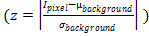 of all pixel values is higher than the value specified is this field. The background signal is measured with the reciprocal binary mask used to detect the Maxima. Note that the lower the value, the bigger the contiguous area are. Default setting is 2.
Attributes: Sets the attributes to be used when evaluating objects in the active Image.
Area: Particles with an Area outside the range specified in this field are rejected. Values are expressed in square pixels or in calibrated square units. Values may range between 0 and ‘max’.
Length: Particles with a Length outside the range specified in this field are rejected. Values are expressed in pixels or in calibrated units. Values may range between 0 and ‘max’.
Width: Particles with an average Width outside the range specified in this field are rejected. Values are expressed in pixels or in calibrated units. Values may range between 0 and ‘max’.
Circularity (Circ.): Particles with a Circularity value (4π × area / perimeter2) outside the range specified in this field are rejected. Values may range between 0 and 1.
Intensity (Int.): Particles with an Intensity value outside the range specified in this field are rejected. The Intensity is defined as the average gray value measured on the channel used to detect the particle. Values may range between 0 and ‘max’.
Z-score: Particles with an unsigned sigma distance value of Intensity outside the range specified in this field are rejected
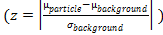 . The Intensity is defined as the average gray value measured on the channel used to detect the particle. Values may range between 0 and ‘max’.
Criteria: Particles that do not fit the specified criterion are rejected (see the Type section). Leave empty to turn this attribute off.
Advanced: Press  to display advanced attributes. Press
  to reset attributes to default.
Local Area: Selects the area of the surrounding rectangular region of interest used to determine the average value and the standard deviation of the background signal. Value is expressed in pixels squared. Selects ‘max’ to use the entire image. Default setting is ‘max’.
Fit mode: Allows any of the four different fit shape mode to be selected (see Contour options for more details).
Exclude Bacteria: If checked, subtracts the binary mask used to detect Bacteria from the selected binary mask. This command is enabled when the Filament mode is selected
Cut-off: The maximum number of Maxima that MicrobeJ will analyze in a position of the active image.
Point color: Assign a color to the center mark or to the medial axis of the Maxima.
Boundary color: Assign a color to the contour of contiguous areas of the Maxima.
Colors(s): Press  to open the Color dialog box.
Tracking: Press  to open the Tracking dialog box.
Test: Press  to test the current Maxima settings on the active position. Scroll and press
  to test the current Maxima settings on all positions of the selected Image.
Created with the Personal Edition of HelpNDoc: Full-featured Kindle eBooks generator